Tuesday, May 12, 2009

Day 14, Fort William to Glasgow, Kilbarchan

Monday 4 May. Here is the group I’ve traveled with the past two weeks. These are a bunch of ambitious spinners, weavers, knitters and sewers. The group came from Florida, New Mexico and California. They had varied interests from scuba diving, to birding to playing the cello. Each group I bring to Scotland has a different personality and I must say that this group asked great questions!If you’ve felt Scotland calling you, I welcome you to come with next year. I’ll have the dates and open registration on my website for the 2010 tour by the end of May.


On the last day of our tour we headed south from Fort William through the stunning scenery of Glencoe glen. A number of movies, including the 3rd Harry Potter, have used this area as a set. The tragic massacre of the MacDonalds of 1692 continues to give this area of natural beauty a tragic air. Andrew played a recording of "Glencoe Massacre" which made us all quietly contemplate. Much of the land in the glen is now owned and protected by the National Trust of Scotland. We stopped at the view point of "The Three Sisters" mountains.
Here is the group I’ve traveled with the past two weeks. These were a bunch of ambitious spinners, weavers, knitters and sewers. The group came from Florida, New Mexico and California. They had varied interests from scuba diving, to birding to playing the cello. Each group I bring to Scotland has a different personality and I must say that this group asked great questions! If you’ve felt Scotland calling you, I welcome you to come with next year. I’ll have the dates and open registration on my website for the 2010 tour by the end of May. Our last bit of nature before heading back to Glasgow was a stop on the shores of Loch Lomand where we sang “The Bonnie Banks o Loch Lomond” It was penned by a prisoner of the Jacobite campaigns before he was executed. He believed that his spirit, upon execution, would travel back the spirit world via the “low road” to the place of his birth, Loch Lomond, while his prison mate, who was to be set free, would have to walk back home to Loch Lomond. So this gives new light to these words: “You’ll take the high road and I’ll take the low road and I’ll be in Scotland afore ye. But me and my true love will never meet again on the Bonny bonny Banks of Loch Lomond.”

Upon returning full circle to Glasgow we lunched at Pollok House in Pollok Park. The kitchens of this fine old mansion have been turned into a café. After lunch we had a short stop at the Burrell Collection, also in the park. Sir William Burrell amassed great wealth in the shipping business and spent his money on collecting artwork from all over the world. There are many tapestries in the collection. Entry to the museum is free and walking around the park which has a large herd of Highland cattle, flowers, and trees, is a green peaceful retreat in the middle of the city, although a bit wet on this rainy day. http://www.glasgowmuseums.com/venue/index.cfm?venueid=1

We ended the tour much the way we started, with historical weaving at the Kilbarchan Weavers Cottage.Christine McLeod is the weaver and property manager at the site. The date on the house is 1723, but people were probably living here as early at 1650. At the peak of handloom weaving here, the 1830’s, there were 800 looms in this parish, a standard 4 shaft, 4 treadle loom. The men were generally the weavers and the women and children wound the pirns that carried the weft yarn in the shuttle. But they do know that from 1880-1890, a mother and her 4 daughters lived in the cottage and they all wove. This house has a treasured collection from
weaver Willie Meikle. He left 18 boxes of weaving samples from everything he made as a production weaver. He died in 1955. The loom Christine weaves on was Willie’s. Willie was famous for making a double weave tartan, very rare. One was just recently donated to the house so were able to touch it. The guild of weavers had 3 cats with shuttles in their mouth on their banner. When the weavers completed their apprentice ship, they swore to eat their shuttles before giving up the secrets of their trade.

Christine is currently thrilled to have been granted a commission to design and weave the cover for the bed in which Robert Burns was born. “I’m obsessed by Burns at the moment. I'm doing what Burns was familiar with. For me its about the history. It’s the story and the weavers that went before.”www.nts.org.uk/Property/62/

I want to thank our coach driver/guides Richard and Andrew from Rabbies Trail Burners http://www.rabbies.com/ onc for driving us 1692 miles around the country. If you can’t come to Scotland, then see it through Richard’s photographs of scenic Scotland on his website. http://www.scotlandthroughthelens.com/

I also want to thank Paul C. for letting me use some of his photographs to supplement my own for this blog.

Travel is a wonderful teacher. We leave our framework of our normal, everyday lives, and are thrust into a culture, which may not seem so different from our own. But as we talk, eat, ride on ferries, visit museums, breath in deeply, we learn in subtle and sometimes not so subtle ways, that every culture has unique things they offer to the world. Scotland has always offered her friendly people and welcoming nature to me and I believe my travelers felt this too. We fly back home and leap back into our lives, but we are not the same. Our being has been touched and changed. I always come home so thankful for the affordable food, fuel and energy we are privileged to have in North America . And I’m reminded to give back the hospitality to visitors in our communities and homes that we received in Scotland. Thank you for blogging along on the journey.

Monday, May 11, 2009

Day 13 Leverburgh to Fort William


Sunday 3 May. We were blessed with smooth water on our Sunday morning crossing from Lewis to North Uist to Skye. Almost everyone on this tour is a knitter. Here is the knitting party on the Leverburgh ferry. You really have to hustle on the drive between ferries from Berneray on North Uist, to Lochmaddy. Our driver, Andrew, showed off his expert driving skills

Skye welcomed us with green rolling hills and lush vegetation on this peaceful island of white cottages and waterscapes We stopped at Slighachen. This is a point between the Red Cuillin and the Black Cuillin mountains, a popular spot for climbers and hikers.


Eilean Donan Castle at Dornie was our next destination. The castle sits on a small little island, making a picturesque view from every angle, especially from a viewpoint above the castle at Carr Brae. Castles have stood on this site for 800 years. The site was a monestary until the 8th century. Vikings ruled here for 450 years. Alexander the 3rd evicted the Vikings and the MacRaes owned this castle from the 1300’s until today. In 1719 the building was destroyed as the castle was a stronghold of support for the Jacobites. The castle stood in ruins for 200 years. In 1912 they started rebuilding the castle and completed the present building in 1932. The renovation was based on the 16th century version of the castle. http://www.eileandonancastle.com/tle.com/


As we continued, snow was evident on the Ben Nevis range. We saw just the lower part of Ben Nevis. At 4480 feet, it is the tallest mountain in Scotland. Typically, only 52 days of the year is Ben Nevis visible.


We lodged in Fort William and enjoyed a fine meal at The Lime Tree restaurant. This B&B has an unusal feature in that as a former church, one part has been converted to a private gallery space that has exhibitions of highland artists and also shows work from the National Art Collections. The current exhibit is Andy Goldsworthy photos of his nature installations. http://www.limetreefortwilliam.co.uk/


Day 12 Harris

Saturday, 2 May. From Tarbert we drove over the bridge to the island of Scalpay to visit Sheila Roderick and John Finlay Feguson at croft #37. Scalpay island has 40 crofts in all. Sheila and John have been farming here for 30 years. The farm goes back in their family to the 1890’s when John Finlay’s grandparents left St. Kilda and came to Scalpay. To make a living, this industrious couple have Hebredian black sheep, a flock of ducks, guineas, chickens and 100 lobster creels. Lobster season is July -December. The size lobsters you can catch is strictly enforced. The sheep are kept at the croft during the winter, but in May are taken to the 400 acres of fenced moorland for common grazing over the summer. Bramble, John and Sheila’s Lewis Border Collie, is 6 years old. Sheila worked with a dog trainer in Stornaway for 12 weeks to train the dog to drive and herd.

The couple still harvest their own peat and grow potatoes in lazy beds. On their Hattersly loom, they weave linen cloth and linsey-woolsey. Currently on the loom is 100 yards of 8/1 Irish linen that will be used by a wedding dressmaker in Stornoway. Some of their fabric ends up in costumes for movies and the theater in London and NY. Both John and Sheila were trained as tweed weavers and work in their weaving shed when they are not doing other work on the croft. Success does not come without long hours and hard work but you can hear the love of this rural life in Sheila’s voice. http://www.scalpaylinen.com/

We all enjoyed sitting around refurbished sewing machine tables to eat lunch at First Fruits Tea Room in Tarbert. Most of us sampled their home baked desserts and Sandy assured us the ice cream sundae was delicious!
Tel: 01859 502 439

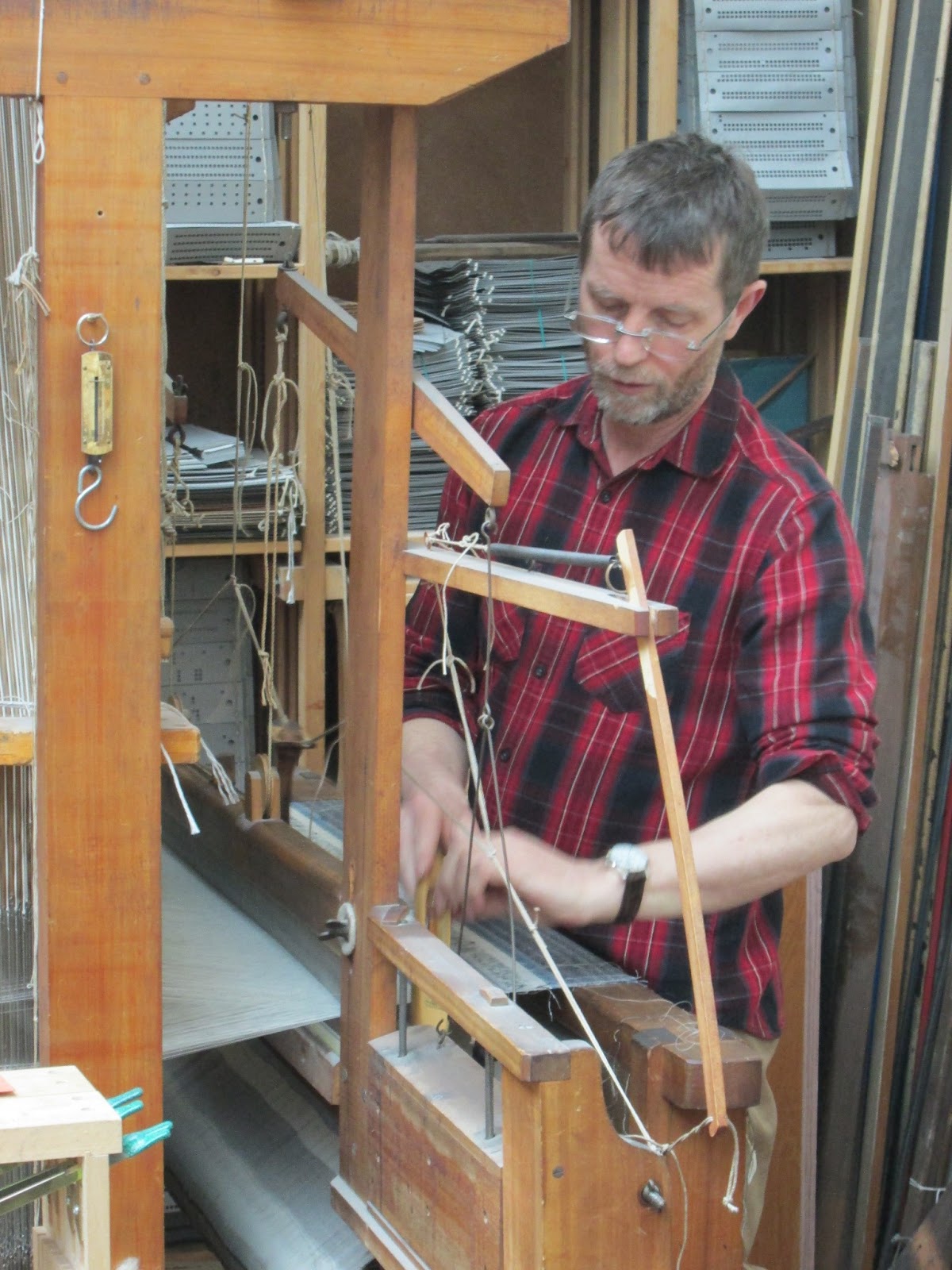
Just down the road in Tarbert we visited Terry Bloomfield, a current Harris Tweed weaver. Today, weavers have to complete a weaving course to prove their skill and competancy before going to work for the industry. There are 120 weavers on the island that supply the industry weaving on Bonas Griffeth double wide looms that are driven with a pedals like a bicycle. The mills in Shawbost and Carloway have reopened and are giving the tweed weavers some work. 1 beam of warp for four, 75 meter tweeds is delivered to his weaving studio. Normally, it would take 2 weeks to weave off the beam, but currently there is only enough work for the weavers to get one beam per month. The fabric is taken back to the mill for finishing and marketing. Much of the tweed currently is sold in Germany. This was the one place the men on the tour stayed longer than the women eyeing this incredible weaving machine! Read more about the history of the industry at http://www.harristweed.org/

Winding our way back to Leverburgh via the Golden Road, I assured the our river the narrow road to Katie Campbell's studio and shop in Plochropol, Harris Tweed and Knitwear was navigable for the coach! Katie and her daughter Catherine weave on wooden looms, the predecessor to the Hattersly loom. Catherine is a fourth generation weaver. Katie has been weaving tweed for over 40 years. She and her sister grew up at the foot of their father who was also a tweed weaver.

"Grannie had 11 girls who all spun. My mom died young. There were 4 of us girls and Dad bought a Hattersly Loom. We went to sleep to the click clack of the loom. It was lovely. It was safe." Katie and her daughter keep two Hattersly looms humming along turning out colorful contemporary and traditionl tweed cloth. Besides yardage for sale, they have their fabric sewn into caps, handbags, jackets, teddy bears, seals, etc. They also have tweed shop in Tarbert. http://www.harristweedandknitwear.co.uk/family.html

At an unlikey gallery, the upstairs of the An Clachan grocery store in Leverburgh on the southern tip of Harris, is displayed a wonderful labour of love. Gillian Scott-Forrest instigated the Millenium Project. A series of hangings was designed, one for each part of the island. The tweed fabric and the wool yarn used for the pictorial embroidery was hand dyed using plant dyes. Of the 1600 people living on Harris, 90 were involved in the project. The images on each hanging depict both history and current events from each area of the island. Each of the 8 panels are 5 fett by 2 1/2 feet. Until the project, called the Harris Tapestry, finds a permanent home, you can get your gas, buy your groceries, have breakfast, and learn of the rich history of the people and the island all in one stop. http://www.harristapestry.co.uk/

We managed to drive by the beaches at Luskentyre between rain showers. The white sand sets off the incredible blue colors of the water making it seem like a movie setting for paradise lost.

St. Clements Church is a wonderful structure, built in the mid 1500’s and restored in 1773. There are 3 crypts in the sanctuary. One can climb up the stairs and 2 ladders to top of the steeple. Margaret Curtis happened to be at the church at the same time as we were and pointed out these interesting carvings on the outside of the steeple.

We capped off our 2 days on the islands with a meal at Rodel Hotel. http://www.rodelhotel.co.uk/ Donnie and Dena MacDonald have converted a former school into a hotel and restaurant where fresh and simply prepared local fare is served. The scallops are hand dived, coming from just down the road.

Saturday, May 9, 2009

Day 11 Lewis and Harris Islands


Friday 1 May. The ferry took us to the Outer Hebridean islands of Lewis and Harris today. We journey the 2:45 minutes by ferry because this is the land of Harris tweed. The definition of Harris tweed: made from the wool of Scottish sheep, spun in the Outer Hebrides, woven by hand, and finished in the Outer Hebrides. When the potato famine hit Scotland 1845-47, Lady Dunmore took the tweed the islanders were weaving, traveled the world, marked up the price 20x and came back and gave the weaver all the profit. Harris tweed became famous worldwide and the demand kept growing. Originally the tweed was naturally dyed. Crotal, a lichen, gave light to dark rusty color. Spinning mills came in 1907 and all the yarn was then aniline dyed.

In 1926, the Hattersley Loom greated increased the productivity of the weavers. The looms had hands free flying shuttle mechanisms and were powered by stepping alternately on two pedals. This is the loom you see Rodney, weaver at Gearranen Blackhouse Village weaving on as we stepped into the past to All the handweavers in our group marveled at the wonderful hands free, shuttle mechanism sends up to 6 different shuttles flying across the warp. The warp is 33" wide set 18 EPI with 18 PPI. In one and a half days, 100 yards could be woven on a Hattersly loom. http://www.gearrannan.com/

Most of the 9 houses at Gearannen were built in the 1850’s. In 1989 a trust was formed to restore the houses and the village opened in 2000. When the blackhouses were built, they were long structures with an open plan. Animals lived and one end and people lived at the other. The roof was thatched. Blackhouses were very similar to the much earlier Viking long houses. Most had open fires in the middle of the living area. Medical officers required that dividing walls and windows be put into the houses by the turn of the century. Some also put in chimney’s. 50% of the rural population on the island still lived in blackhouses up to 1939. Mary, our guide, offered us these thoughts. “The people who lived in these houses were penniless. But they had a lot of thing we need here now…community spirit and tolerance. We are losing the richness of simplicity.”
Dun Carloway Broch rises up on hill in the midst of current day farms. Perhaps ¼ of the original broch still stands. But the impressive stonework remaining gives a good idea of what life in this multi-storied landowner’s home from the Iron age was like. We rain joined the high wind just as we arrived, so just a few of us blew up to the broch. www.stonepages.com/scotland/duncarloway


On the way to Callenish Standing Stones, we picked up local archeologist, Margaret Curtis For an hour she walked us around the stone formation, telling us what archeologists have discovered, about the formation over the past 200 years. She has lived in the area and worked on Callenish and the other stone circles and formations on the island for over 30 years. The cross formation of stones intersecting this circle sets it apart from stone circles we saw on Orkney. Callenish is the second largest stone circle in Britain, after Stonehenge. Margaret used illustration boards that showed us drawings of the formation before excavation removed several meters of peat. Much of her research has involved the location of the moon on it’s yearly path and how the moon aligns with certain stones. The sun alignment also enters into the story of the stones, Margaret doesn’t think the sun alignment was as important at this formation as the moon. Despite what felt like gale force winds, we followed Margaret dutifully around the formation as she engaged and enlighted us with her enthusiastic and informative insight into the mysteries of the stones.www.undiscoveredscotland.co.uk/lewis/calanais

Harris lies south of Lewis. The islands are actually connected by the road, but as you reach Harris, the hills rise up and the landscape becomes much more rocky. Harris also has brilliant sandy beaches. We stayed in Tarbert tonight. The name comes from the Norse word “tairbeart” meaning draw-boat. Here you get the feeling that if there was enough work enough, folks would never leave.

Day 10 Northwest Scotland, to Ullapool

Thursday 30 April. Nature provided our venue of the day. We departed St. Margaret's Hope on South Ronaldsay, Orkney on the 8:00 am ferry and pulled into Ullapool in the late afternoon. This drive across the North and the Northwest of Scotland is no ordinary journey. This is the least populated, remote and rugged and least visited are on the mainland. It is my favorite landscape in all of Scotland. Once past Thurso, it is mile after mile of rocks, beach, hills, water, heather, birds, grazing sheep, and finally a herd of Highland hairy coos to photograph.
The road often goes to one lane. Dunnet Head is where the North Sea meets the Atlantic Sea. We were blessed with morning sunshine that added to the richness of the color of the sea and stone. When Will, one of the consumate birders on the trip, wasn't looking through his binoculars, he was snapping photos.

Just outside of Durness, we visit Balnakeil Craft Village. www.durness.org/Balnakeil Once a military base, it was taken over by hippies when the military left and now is inhabited by small shops and craft studios. I told the group that the reward for all this sitting and riding today was
a a stop at Cocoa Mountain for dessert. They specialize in truflles with unique flavours like strawberry, lemon pepper and decadent hot chocolate.
You can't miss this heavenly stop if you like chocolate. >http://www.cocoamountain.co.uk/

We stopped at Highland Stoneware Pottery shop in Lochinever. The driveway and garden of the shop proved very entertaining with large stones, an automobile, a gigantic concrete sofa, all covered with broken pottery. http://www.highlandstoneware.com/

Before heading on, make sure to drive into town and get a homemade pie from the Lochinever Larder. Their savory or sweet pies are in such demand, they post them around the country. http://www.piesbypost.co.uk/


Once we reached Ullapool we settled into our B&B's. You see the view here from the backyard of the B&B. No one ever wants to leave this idyllic spot. A hearty thank you to Charlotte at Dromnan Guest House http://www.dromnan.com/


Friday, May 8, 2009

Day 9 Mainland, Orkney

Wednesday, 29 April

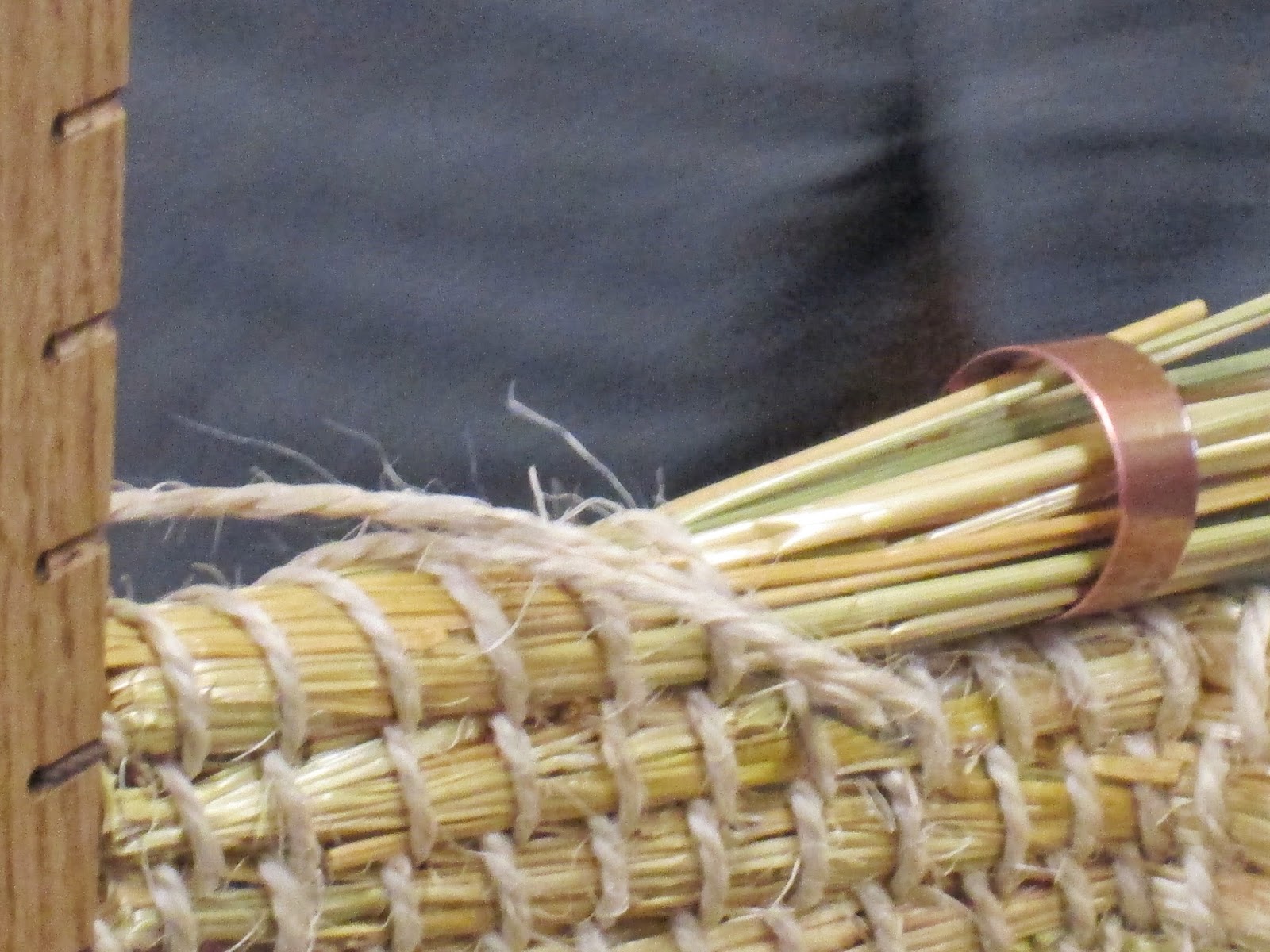
You can't be in Orkney without spying old or new Orkney chairs. Locals made these chairs for hundreds of years with materials they had at hand. The chairs combine wood for the frame and oat straw coiled and stitched with sisal for the chair backs. We saw the chairs being made first hand at Fraser Anderson's workshop, Orkney Hand-Crafted Furniture, in Kirkwall.

Just as in chairs of old, he gathers driftwood between November and February. The driftwood, mainly pine or beech, cures for 2 years before he uses the lumber for chairs. The oatstraw is grown locally by his cousin and has to be cut with an old fashioned binder. It takes 4 sheaves for one chair back. Each stalk in the sheaf has to be stripped by hand. It takes up to 3 weeks to complete each chair and Fraser makes up to 30 chairs a year. He is one of 3 professional chair makers on Orkney. Fraser is honoring the tradition by repairing old chairs and designing new shapes and styles of chairs, rockers and stools. http://www.orkneyhandcraftedfurniture.co.uk/

The big island, or as Orcadians call “mainland” is home to numerous stone circles and structures dating back as far as 5000 years. Nowdays, the 17 of the 65 islands that are populated are home to 20,000 people, 100,000 beef cattle, 68,000 sheep and one fishing fleet, on Westray.

We traveled west to the heart of Neolithic Orkney. Modern technology has shown that the stone monuments above ground are just the tip of the iceberg of all the ancient stone sites under the earth in this heart of the island. There is currently a new archeological dig exploring a newly found site not far from the Standing Stones of Stenness.

Michael, our local guide while Andrew had a day off, told us tales and speculations about these sites. Stenness means “stone point” and indeed the tall stones still standing are pointed on top, but just 3100 years old. Also known as the Temple of Moon, couples came to perform a marriage ritual which would bind them together for one year and one day. After that period, they would have to come back to the stones to renew that ritual or to break the contract. Thus was their system of “marriage in installments.” www.orkneyjar.com/history/standingstones/

The Ring of Brodgar once had 60 stones standing. Brodgar means “farm by the bridge.” A ditch, 11 feet deep and 33 feet wide encases the stone ring. One story goes that giants came to this ground to dance. Hands joined, they danced around and around, forming the ditch. They were having so much fun, they didn’t notice the sun rising. When the sun’s rays touched them, they turned to stone, thus forming the stones in the ring. Each Dec 31, they come alive, rise up out of the ground, walk down to the lake and have a drink. Then they go back to the ring and become solid stone for another year. This sounds much more believable when Michael tells the story!
The 2500 year old ring is said to grant the gift of fertility to anyone who runs around it counter clockwise 3x without stopping. Considering the large circumference, this running ritual also meant you were in shape! As we walked the ring, many of us touching each stone, the wind blew us along, urging us to consider what ancient wisdom moved the people to build such impressive sites. What did they know, that we have long forgotten? www.orkneyjar.com/history/brodgar/

Stromness is the 2nd largest town on mainland Orkney with a population of 2000+. We enjoyed a lunch stop here, dining at Julia’s Bistro. This cafĂ© sits right off the waterfront and had one of the best desserts I ate the entire trip, raspberry almond cake. Several of us on the trip took pictures of our food, me because I like to cook, eat and remember. I also like to help erase the commonly held myth that Scottish food is boring and not tasty.

Maybe that was true in past decades, but these days, food is fresh, locally sourced when possible, and tasty. You don’t have to look for “hormone free” on the milk bottles, because all milk in the UK is hormone free. Orkney cheese is really nice. I purchased some Grimbister Farm cheese with caraway and mature Orkney red cheddar for the group. Combine with a Carr’s cheese cracker, and the tummy is quite satisfied.

Skara Brae was uncovered when a storm hit William Watt’s farm in 1850 and eroded the beachfront. The settlement wasn’t excavated however until 1928. This fine example of a stone-age community was quite advanced as they even had a sewage sytem and a stone trough area they filled with water and hot rocks to steam the sea life they ate. www.orkneyjar.com/history/skarabrae/

Corrigall Farm Museum in Harray is a wonderful example of rural agricultural life on the island. Implements, tools and household furnishings from the 18th-20th century fill the buildings. Inside the buildings are all kinds of fascinating things like a simmon, rope that was made from twining grass, a spoon kaise, for holding cutlery, an ingenious mousetrap, an old Orkney chair, loom, and spinning tools and usually some North Ronaldsay sheep, the breed that eats seaweed! But they were not there today. http://www.orkney.org/museums/


A tour of the Highland Park Distillery in Kirkwall lead us through the entire process of distilling single malt whiskey from the malting of the barley to the where the magic happens in the aging process. Highland Park single malt has a peaty taste and it light amber in colour. The taste comes from the malting process of roasting the barley with peat.

This is one of just 5 distilleries in Scotland that malts their own barley. The barley comes from mainland Scotland. The barley is soaked in water for two days, so it sprouts. Then it is spread out on a concrete floor for 5 days and turned to prevent it from sticking together. The kernels keep germinating on the malting floor. Then the green malt is placed on a mesh floor far above the fire kiln where it gets two firings of 18-20 hours each. The first four layers of peat are used in the first firing to give the barley a smokey flavor. Then it goes through a second firing fueled by coke, a form of coal. This second firing dries the malted barley.

After malting the grain is turned into a mash. The mash goes through 3 soakings. The distilling of the sugars into alcohol is a two-step process done in huge copper cookers. They age the whisky a minimum of 12 years in both Spanish sherry barrels. Nothing like a dram of whisky to settle the stomach before dinner! http://www.highlandpark.co.uk/distillery/

Each Wednesday night, the Orkney Accordian and Fiddle Club practices at the Ayre Hotel in Kirkwall. Tonight, being the 4th Wednesday of the week, was “open night” which is a concert. They were joined by the Strathspey and Reel society and played for almost 3 hours. Where is that dance partner when I need him?

Music and bands abound in Orkney. They showcase Orkney and Scotland’s finest in the annual Orkney Folk Music Festival, May 21-24, 2009. www.orkneyfolkfestival.com

Thursday, May 7, 2009

Day 8 Kirkwall, Orkney


Each tour includes a one-day workshop with a Scottish artist. This time we worked with Ingrid Tait. I first visited Tait and Style in 1997. In Ingrid’s studio I saw this amazing needle punching machine. That was my first exposure to machine needle felting. Now I own several home models that look like a sewing machine. Ingrid’s huge industrial machine with hundreds of needles makes things possible you could never do with a 7 needle Babylock. Imagine, her machine as an ocean liner and ones like mine, an inflatable kayak.

Ingrid started out showing us examples of work she has produced. For 17 years Ingrid has run this company that creates knitted and felted scarves, throws, pillows, and accessories for the high fashion market in London and New York. She discovered a needle-punching machine in Yorkshire that was used to make industrial materials. Sensing it could be retooled to work with wool fabric, she acquired the machine and has been felting her designs with fleece, yarn and fabric onto commercially woven wool. http://www.taitandstyle.co.uk/<

Student created designs and chose fleece, yarn, and a variety of fabrics to create the design elements. Then learned how to tack them onto a wool and angora scarf blank with needle and thread. By mid afternoon, the scarves were ready to be fed through the industrial needle felting machine. It has a conveyor belt not unlike the airport conveyor belt that carries your hand luggage through the xray machine. The bed of Ingrid’s machine is about 4 feet wide. The scarves are sewn together with cheesecloth type netting between them. The bed moves the scarves through the needle head unit which moves up and down. After the first pass, the tacking stitches are removed from the design elements, then the scarves are fed through the machine a second time.

After rolling the scarves through the pressing machine, the group is ready for a style show! Ingrid is a fabulous designer and a charming person to work with Everyone enjoyed a day to be creative instead of being a tourist.


Tait and Style is located in the Wine and Wool shop in the courtyard behind The Long Ship just across from St. Magnus Church. Ingrid and her husband Duncan run both these shops. The Long Ship sells jewelry designed by Ola Gorie, Ingrid’s mom. Although retired now, her popular jewelry designs are still available. When Duncan isn’t busy discovering the nextgreat wine to provide to the restaurants he supplies, you might hear him singing and playing guitar with the Lonestar Swing Band. This is the only westernswing band in Orkney, perhaps Scotland. I caught part of their rehearsaland wished I’d had a parter to 2 step with to the strainof “Roley Poley”

The post dinner walk in the brisk air and sunshine inspired me to shoot town scenes. Here are a few of my Kirkwall impressions.

Tuesday, May 5, 2009

Day 7 South Ronaldsay and Kirkwall, Orkney

Monday 27 April

We started the day at Tomb of the Eagles on South Ronaldsay. Ronnie Simison found a Bronze Age dwelling on his farm in 1958 at the edge of a field. His family runs the visitor center and gives you an excellent introduction to the artifacts and bones found in the dwelling and the Tomb before you walk out one mile to the edge of the sea for viewing. Here are Pam and Sandra on the windy trek. The Tomb of the Eagles is named so because the bones of 14 sea eagles were found in the tomb in addition to the bones of at least 340 people. The tomb dates back to the stone age, between 4000-5000 BC. The tomb was excavated in 1976. 2 archeologists working on site figured the tomb was used for 800 years. To see the inside of the tomb, you either crawl or pull yourself in on a little trolley cart, similar to a mechanic’s creeper. Will chose to crawl! www.tomboftheeagles.co.uk

It’s easy to see why the blues in Leila Thomson’s tapestries are so stunning. Out the window of her Hoxa studio and gallery the water flashes a variety of shades of blue depending on the amount of clouds or sun. After graduating from art school in Edinburgh in 1980, Leila came back home and has been designing and weaving ever since. 13 years ago she opened her gallery and now visitors from around the world view her stunning work.

Leila weaves private commissions, working from her own charcoal sketches and full size cartoons. Working full scale from the initial sketch, she feels her woven work comes out more like a drawing. She interprets and chooses all the colors as she weaves blending a variety of fibers. This really gives the tapestries an energy and vitality often lacking in other pictorial textiles. Words and pile texture are also trademarks in her designs. Leila always weaves to music ranging from Metallic to the London Philharmonic, she likes the volume loud. As Leila readily admits “I work in a state of splendid isolation.” After the tourist season ends in September that is. http://www.hoxatapestrygallery.co.uk/
Orkney abounds in artists. One can pick up maps of the Orkney Craft Trail and visit many studios open from after Easter until the early autumn. When I asked one of the Orcadian artists we visited today why the islands are such magnets for creativity, she suggested that it was the influx of artists who came up here from England that got the movement started in the 60’s.

Driving from South Ronaldsay, you cross several of the Churchill Barriers. The British fleet was stationed here in WWII and the barriers were build using labor of POWs to protect the fleet from the Germans U boats. Before the large concrete barriers, salvage ships were lined up end to end and sunk to create the barriers. One German U-boat managed to penetrate those original barriers and sunk a the HMS Royal Oak, with the cost of over 800 lives. Today the area around the seven remaining WWI German sunken ships is one of the top dive sites in the world.
http://www.undiscoveredscotland.co.uk/eastmainland/churchill/index.html

The Italian Chapel stands on the Island of Lamb Holm just over the fourth barrier. Italian prisoners of war who built the barriers and worked in agriculture, were given a Nissen hut to turn into a chapel. Domenico Chiochetti designed the chapel and the prisoners worked to decorate and furnish it over a period of 3 years with materials they could scrounge. When the prisoners were released at the end of the war, Chiochetti stayed onto finish the work on the chapel. The detailed painting and metal work is a testament to what can be created from nearly nothing when you have dedication and vision. In 1960 the BBC Italian service broadcast that they were looking for the men in charge of building the Italian chapel. Chiochetti responded and the islanders invited him back to refurbish the painting on the inside of the chapel. There continues to be strong ties between Italy and Orkney. http://www.scotsitalian.com/orkney_chapel.htm

Sheila Fleet, is the sister of Leila Thompson. There is no shortage of artistic talent and vision in that family. In 15 years Sheila’s business has grown to 42 employees. Sheila is the chief designer, creating 3 new collections each year. She has done a total of 150 collections so far. We toured the workshop to understand the lost wax method used to produce her jewelry. I found two of the steps extremely interesting. The skill of the master pattern maker who takes each design and hand cuts the metal master has to be exacting. The enamelists also have a painstakingly detailed job, applying the enamel mixture (ground up glass and distilled water) to the jewelry, then curing each piece, one at a time in a tiny kiln on their worktable.
Sheila’s philosophy backs up her talent and work ethic to spell success. “ A measure of success is how you feel about what you are doing. I’m still enjoying myself. You have to look at keeping the balance. Find something you really like doing and you’ll never work again.” If you can't come to Orkney to meet Sheila, she has galleries in Edinburgh and Glasgow. Many of the group left Sheila's wearing a peice of jewelry to remind them of the pristine landscape that inspires Sheila's fabulous designs. www.sheilafleet.co.uk/

Just down the road lies Mine Howe. In 1999 farmer Douglas Paterson bought the land and excavated the site. 29 steps lead down to a room barely big enough for 3 people. What was this chamber used for? No one knows. This site is indicative of Orkney. Many ruins are still to be uncovered, or left to posterity, untouched, the mystery to remain a mystery. www.web.ukonline.co.uk/minehoweweb.home.html

Kirkwall, the largest town in the islands is our home base for exploring the main island. We stayed at the West End Hotel. Proprietor, Mr. Leslie and his staff offer excellent hospitality and comfortable rooms. www.orkenyisles.co.uk/westendhotel/

12 years ago as I walked off the ferry with a large pack on my back, I met the Mina and Arnie Flett. Arnie drove me around to visit artist studios in exchange for me helping him warp a loom he was given. A retired pipe major, Arnie still teaches piping to dedicated students, and he and Mina entertained us with piep tunes and poems after dinner tonight. Mina still glows as she listens to Arnie play a polka he wrote for her. Sitting just a few feet from Arnie as he played tunes he has composed, I discovered that he has the unique ability to circular breath as he is playing, a rare gift for a piper. Skillful artists, ancient stones, good food and conversation and sharing of music, was this not a fine day?

Friday, May 1, 2009

Day 6 From Oyne to St. Margaret's Hope

Sunday 26 April. This, our biggest travel day so far, took us through 5 regions of Scotland. Aberdeenshire, Invernesshire, Rosshire, Southerland and Orkney. We started in Insch in the shadow of Bennachie, the tallest hill in Aberdeenshire, drove through the Speyside region towards Inverness. A number of windmills dot the fields in this area. Scotland is dedicated to replacing two old nuclear power plants and reducing dependence on oil by focusing not just on wind power, but solar and tidal power.

We stopped at the Culloden Battlefield Visitor Centre. This famous battles lasted just 45 minutes and was the end of the Jacobite uprising. The visitor center overlooks a flat field where on April 16, 1746, the Duke of Cumberland sent Bonnie Prince Charlie fleeing. Not only were the Jacobite forces massacred that day, after the battle, Cumberland, know as "The Butcher" ordered all Jacobite supporters in the Highlands hunted down and slaughtered after the battle. http://www.nts.org.uk/Culloden/Home/


For a musical interpretation, listen to the McKassons "Culloden" on their recording "Tripping Maggie" http://www.themckassons.com/recordings.htm

Clava Cairns lies several miles from Culloden but receives just a fraction of the visitors. This Bronze age burial site sits among pastures and fields. In the UK, the Bronze Age was the period from 2700 to 700 BC. The site is comprised of three stone mounds and some standing stones, trees, and a few interpretive signs. As the group strolled through the site, which isn't much larger than a football field, I think the atmosphere seeped into our beings and most talking ceased. How can we ponder something so old when we live in a time when a car is old after 3 years, a dress is out of fashion after one year, and buildings that are 80 years old are torn down to make way for modern structures? http://www.mysteriousbritain.co.uk/majorsites/clava_cairns.html

As we headed to lunch, we drove along the Moray Firth. You are more likley to see dolphins in these waters, more than any other place in Europe. We lunched at The Storehouse at Foulis Ferry on Cromarty Firth. The storehouse is a "girnal" meaning "grain store." Girnals are unusual in the Highlands. They were built as close as possible to water transport in the 18th and 19th centuries, before there were railways in the area. This efficient eatery offers tasty food and excellent service. I can highly recommend the roast beef Yorkshire pudding.

From there the A9 winds north along the North Sea. Numerous oil rigs are visible off shore. Along the way, just a few miles off the main road along the River Brora is the studio of Joan Baxter, tapestry artist. Joan trained in Edinburgh and Poland and has been weaving tapestry commissions for over 30 years. Joan is inspired by the land and landscape. She and her husband live on a seven acre nature preserve. One can see the influence on the land in her traditional and mixedtechnique tapestries. Joan loves mixing colors, "Why use one colour when two will do?" She often works from a concept and loose sketches, preferring not to use a detailed cartoon, so the work can develop as she weaves. Joan also teaches tapestry to serious students.

Joan's husband, Steven Clark, is a bladesmith and musician. He apprenticed with a knifemaker and picked up the skill quite quickly. He likes giving old steel new life as a knife and believes knives should be functional, not just decorative. He likes using a variety of materials for the handles, but especially antler. Between caring for the land and creating things with their hands, there is rarely a wasted moment at Ford House. http://www.joanbaxter.com/

Our final destination on the mainland was the ferry at Gills Bay. http://www.pentlandferries.co.uk/ This is the shortest ferry crossing to Orkney at this time of year, just one hour. Prepared with motion sickness drugs and pressure point bracelets, the travelers boarded the new Pentalina ferry for a pretty calm crossing. Some of the group found the best way to sail to St. Margaret’s Hope is with the wind in your face on the open deck.

St. Margaret’s Hope is on the island of South Ronaldsay. A quiet, sleepy little town, it is a great place to spend the first night on Orkney. Many visitors to Scotland don’t travel to Orkney, and even many mainlanders have never been here. I discovered the barren, enchanting pull of these islands on my first trip to Scotland. Orkney and the Shetland Islands lie between mainland Scotland and Norway. The islands once belonged to Denmark, and the Nordic influence in the place names (St. Ola, Stenness, Brodgar) is especially strong. Orcadians pride themselves in their heritage and not being mainlanders. Of 65 islands in Orkney, 17 are inhabited with a total of 20,000 residents. However, more and more folks are discovering this magical place. This summer over 60 cruise ships will dock in Kirkwall. One more reason I like to tour off-peak.

Thursday, April 30, 2009

Day 5 Dundee and Oyne

Saturday 25 April

To go from Edinburgh to Dundee, you cross the new Forth Bridge. The old Forth Railroad bridge, a cantilever bridge, is considered to be the 8th wonder of the world. Completed in 1890, it was the world's first major steel bridge and still carries many trains a day. The bridge has only been closed down 5 days in its history for repairs. http://www.forthbridges.org.uk/railbridgemain.htm
Dundee lies on the River Tay and is known for 'jute, jam, and journalism.' It was once known as “Jutopolis.” Over 50,000 workers worked in the jute mills. Verdant Works Jute Mill, built in 1833 , was the 16th largest of 61 milles. The last of the jute mills closed in 1997. Verdant Works is now a museum depicting the days when jute was king in this http://www.verdantworks.com

Jute fiber was brought by ship from India. Large bales were brought to the factories where it was processed, spun into yarn and woven into cloth. Boys only worked in the mills until they were 18, when they were made redundant. Women comprised the majority of the workers in the mills and had a lot of power. We had an excellent guide, Earl Scott, who led us through the interpretive displays.

Each time I come to the museum there is something new and this year it was an excellent film showing the history and the current jute industry in India where most of the world’s burlap is woven today. Now there are no jute mills left in Dundee. Some of them have been torn down, others turned into housing and others refitted for other industry. But no industry since has matched the success of the jute mills in the 19th and early 20th century. A number of songs tell the stories of working in a jute mill. My group, Straw into Gold has recorded 2 of them, Sheena Wellington’s “The Weavers o Dundee” and Mary Brooksbank’s “The Jute Mill.” You can listen to this second song at http://www.singingweaver.com, by clicking on the revolving musical symbol on the home page.

A beautiful three-masted, 30’ x 128” ship, the Discovery, sits in the Dundee Harbor. Built in 1901 as a research vessel, it was designed for the artic with a 27” thick hull comprised of 3 layers of pine, oak and fir. You can see the saltboxes in the hull that were filled with salt and pushed into the hull, like drawers, to absorb any excess moisture between the hulls. The ship was powered by a double expansion engine, made in Dundee, which was powered by two boilers. These boilers were fed coal. For the first Antarctic voyage, 400 tons of coal was stored in the hold and 40 tons on the deck.

Captain Robert Falcon Scott led an expedition of 47 men to the Antarctic to attempt to be the first to reach the South Pole. The crew included 37 sailors, 5 officers and 5 scientists. The scientific study focused on the five areas of geology, meteorology, magnetism, zoology and biology. With space for only 18 sleeping hammocks in the crew quarters, the men worked and slept in 12 hour shifts. The main meal was as noon. Each crew member was given 1 glass of rum with lunch. In New Zealand the ship took on 40 sheep that were slaughtered and hung frozen on deck. The diet was supplemented by penguin, sea birds and seals. 100 pounds of dry mustard was in the ship’s pantry to disguise the bad taste of the penguin and other birds. Every person was given a dose of lime juice each day to prevent scurvy.

Officers had a finer sleeping and galley area, but it was also the coldest place on the ship. The officers would wake up with their blankets frozen to their beds. When the ship reached the Antarctic, they became frozen in sea ice and remained there for 2 winters. While scientists conducted research, Scott and 2 others attempted to reach the pole via foot. The 19 dogs brought on the journey to pull the supply sled all died. The mission was unsuccessful. In Feb 1903, the pack ice broke up freeing the Discovery to sail back to Scotland. Scott died on his second attempt to reach the pole which was finally achieved by Roald Amundsen. http://www.rrsdiscovery.com

We dined tonight at Gadies, the new restaurant attached to Touched by Scotland gallery in Oyne. Robin and Jan offer food that looks beautiful and tastes delicious. http://www.thelandofmacbeth.com/tbs/

After dinner, G&T entertained us with songs of the sea and songs of Scotland. A local duo, they are known for their harmonies and light-hearted presentation style. Trish Norman and Gaye Anthony travel around the UK and Europe performing at festivals. Their voices blend in sweet harmonies while trading off the lead. Trish’s high, clear, lilting soprano is grounded by Gaye’s rich, round alto voice. They accompany themselves with guitar. They sing songs about the sea, fishing, and even taught us the chorus to their famous haggis song! Their stories and banter interspersed between songs kept us all smiling and laughing and singing along. Gaye and Trish have made 3 recordings. You can hear their joyous sounds at www.mypsace.com/gtgayeandtrish

Tuesday, April 28, 2009

Day 4 Edinburgh

Friday 24 April
Dovecot Tapestry Studios sports a dynamic new location. A few blocks off the Royal Mile and just down from the Museum of Scotland, the city pools sat decaying since the 1990’s. The Victorian building, designed by Robert Morham, was constructed in 1885 and housed two pools, one for ladies and one for men. After a complete renovation designed to retain the Victorian architectural features, the building now houses two galleries on the ground floor, Dovecot Studios and offices on the first floor, and two additional floors of rental office space.
Except for a break during WWII, the studios have been weaving tapestries for commission since 1912. After the war, they began collaborating with well-known artists, a tradition that continues through today. One walks into the weaving studio flooded with natural daylight and colors of yarn cones vibrating from the walls and is dazzled. A viewing gallery rings the perimeter of the large open studio at second story level. Work of past and present Dovecot weavers is displayed here. The studio/gallery, former site of the large pool, feels like a warm, inviting sanctuary.

Three of the four Dovecot weavers were in the studio today. All generously spoke with us. Douglas Grierson, head weaver, has been working at Dovecot for 48 years. A masterful weaver who is drawn to geometric forms, Douglas believes that “the (artistic) translation of tapestry only comes by the weaving of many, many tapestries.” A humble, soft-spoken man, his many tapestries hanging in studio, attest to his love and mastery of the art. Each of the weavers have been asked to create a piece to commemorate the new studio space. Douglas’s piece, “Bath and Bathers” depicts bathers from famous artworks in history. David is writing a book about the history of the studios for the 2012 centennial.

David Cochrane is working on speculative piece, a sample that hopefully will gain the studio a new commission. He showed us how he sews up the slits between the woven motifs while he weaves. David was an apprentice at Dovecot for five years and has been weaving tapestry there now for twenty-four years.

Jonathan Cleaver just joined the workshop in August. He studied at Edinburgh College of Art and did textile conservation before coming to Dovecot. Douglas and Jonathon are working together on Jonathan’s piece, which has the working title “Pool Sounds.” Often the weavers work side by side on a piece. Each tapestry woven at Dovecot has the weavers’ mark and the Dovecot symbol woven into the piece. Naomi Robertson was not weaving today but has been with Dovecot almost 20 years. By 2012, the 100th anniversary of Dovecot, the four weavers will collectively have one hundred total years of weaving experience amongst them.

This new venue will allow for classes to be offered and gives tapestry a much wider public exposure. The public can watch the weavers from the viewing gallery the first Tuesday of the month. http://www.dovecotstudios.com

The two galleries on the ground floor are open to the public Wednesday –Saturday. The small gallery is showing an exhibition based on the paintings and graphic works of Barbara Rae. The tapestries and tufted rugs express the energetic, colorful, and outspoken character of the artist. She particularly likes her paintings translated into the rugs because the rugs both absorb and reflect the light. Douglas creates these tufted rugs with a machine that looks like a hand drill. But the tool both punches the yarn through a polyester canvas and cuts the yarn creating the pile surface. Power tufting is a much faster process than tapestry weaving and allows for fluid motion and expression.

The large gallery currently hosts, the “Age of Experience”, a collection of textiles, glass, ceramics and jewelry by mature artists. The show includes woven work of the late Peter Collingwood, basket maker David Drew, and Ikat hangings by Mary Restieaux. The exhibition is brought to Dovecot by Innovative Craft, a new Edinburgh based organization for the promotion and understanding of contemporary craft.

Travelers were turned loose in the old town of Edinburgh for the rest of the day after a wee overview city tour from Richard our veteran driver of the past two tours. We bid goodbye to him tonight so he could return home to be with his wife and 17-week old son. Here is John, the hiker of the group, at the top of Arthur’s Seat. He's looking out over the Firth of Forth with the city in the background.


Annette and Max of Hotel Ceildh-Donia have hosted us during our Edinburgh stay. The beds are very comfortable and hospitality top notch. The house restaurant serves up tasty Scottish fare prepared by their chef/son. I lick my plate clean for his Sticky Toffee Pudding ! www.hotelceilidh-donia.co.uk

Sunday, April 26, 2009

Day 3 New Lanark and Selkirk


Thurday 23 April. Each day of the tour, I share a poem that is relevant to the place or area we are traveling. As we went to the Borders today, we passed the home of the poet known as The Ettrick Shepherd, James Hogg. His poem, "A Boy's Song" eloquently describes the rolling green hills of sheep and cattle pastures bisected by the rivers Tweed, Clyde and Yarrow. One stanza goes...."Where the mowers mow the cleanest, where the hay lies thick and greenest, there to track the homeward bee, that's the way for Billy and me..." This time of year is too early for haying. Instead Scottish Blackface or Cheviot ewes, often with 2 lambs cover the pastures and send my travelers into constant cooing“oooh look at the lambs!”

New Lanark World Heritage Site is the site of a former mill where cotton was spun. Today, in one of the restored mill buildings, there is a small production of wool yarn being spun on a large spinning mule for the sake of education and for profit.

The community was built below three falls on the River Clyde in the late 1700’s by David Dale. The mill ran on power generated by the falls. Today New Lanark still produces hydropower that runs the community, with enough left over to sell back to the power grid. The mill was purchased and run by Robert Owen from 1800-1825. He was a social reformer and forward thinker far ahead of his time. He ideas were not popular with other mill owners. But his efforts gave him the title “father of trade unionist movement” in Scotland. He banned children from under age 10 from working in the mill. He started the first nursery school in the UK. Children from ages 2-9 went to school while their parents and siblings worked in the mill. Once children reached age 10, they worked in the mill and then attended classes at night. Mr. Owen treated his own 7 children no differently than he treated the children of the mill workers.

The school was built by money generated from the company store which was run as a cooperative. New Lanark was the first cooperative that lead to the foundation of The Co-op, a grocery store still thriving around the country today. In school not only were reading, writing, and arithmetic taught, but the children studied dancing, music, and nature studies.

The workers lived in buildings just across from the mill. A family of 10 may share one room, but they were warm, well fed, and had health care provided by the mill doctor. The work day started at 6 a.m with a breakfast break at 9 a.m. and lunch break in the middle of the afternoon. The work day ended at 7pm. The mill ran 6 days a week and was closed on Sunday. They produced 50,000 miles of cotton per week. The mill operated until 1968 when it could not operate profitably. The mill buildings sat empty and fell into disrepair from the elements and vandalism. A foundation saw the value in restoring the site and started the vast restoration of the mill in the 1970’s. The restoration still continues today. The newest addition is a roof on top of one of the mill buildings.

The site is a glorious example of public and private cooperation to preserve an important part of Scottish history and to educate generations to come. Today 150 people live on the site. Many visitors may only take the Annie McLeod ride. But I encourage you visit the school building, visit Robert Owen's house, spend time looking through the exhibits in Mill buildings 1&2 and the housing block, and take the hike to all 3 water falls. Here are two Sandy and Donna with our guide Ian Mackenzie and ready to start the Annie McLeod ride.
I was very struck by this place on my first visit 12 years ago and each visit deepens that impression. I think it is the most tasteful and educational tourist site in Scotland. www.newlanrk.org/

Locharron of Scotland was the afternoon venue. One of the few weaving mills left in the Borders, this Selkirk-based company weaves tartans and fashion fabrics for designers and companies around the world. They are housed in a former mill building that was refurbished in Riverside industrial area and feature a huge showroom of their goods. The business is family owned with many of the workers long time employees. A guided tour starts with the dying process of the wool.

The process continues with cone winding, winding the warp and then tying onto the looms. If the current order has the same number of warps per inch as the previous job, a machine can tie on the entire warp in one hour. If an order has an unusual set, a worker has to hand thread the heddles, about an 8 hour job, just like us labor intensive hand loom weavers have to do in our studios.

The Swiss power looms the company used are 10 years old and cost 250,000 pounds each. But still much hands on work and checking is required to retain the high standard of quality the company demands of their cloth. The women in quality control handle and inspect every yard of fabric after it comes off the looms. If an error is found, they may have to hand needle in yarn to fix the problem for up to a 40-yard length. The finishing of the cloth is done in Galasheils. Locharron has their own in-house design team. The head designers spend half their time in New York and Japan. In addition to traditional and private tartan designs, the company weaves fabrics for fashion houses around the world. 4 different weights of tartan are woven by the company. Here Anne and Donna inspect a delicious drapey lightweight weave. When I asked the guide how Lochcarron has survived when most other mills have closed, he answered simply “quality. When companies buy from us, they know what they are getting.” Sadly these days, you can purchase cheap knock-offs of tartans made in India. Always look for the label “made in Scotland” to assure you are getting the authentic thing, made with quality and pride in Scotland. In the photo you see Donna coveting purple tartan cloth.http://www.lochcarron.com/

Thursday, April 23, 2009

Day 2 Paisley

Wednesday 22 April. We started at the Paisley City Museum. This is a free museum and the oldest municipal museum in Scotland. It houses one of the best collections of Paisley shawls in the world. The collection curator, Valerie Reilly, gave us a detailed talk and slide presentation of the history of the Paisley shawl from the design's origins in Babylon where it was a fertility symbol, how it spread to the Kashmir region of India, and then finally to Europe. The East India company started importing them to Europe in 1780.

Originally the shawls coming from Kashmir were made of pashmina goat fiber that was collected from bushes where the goats would rub it off. These shawls were woven on simple wooden looms and took months to weave. The limited source of the fiber and the time it took to weave these shawls in Kashmir made them very expensive. Josephine, Napolean's wife, had 200 shawls in her wardrobe. By the late 1700's the shawls were being produced in Edinburgh, Norwich, France, Russia and Paisley on draw looms. Paisley had highly skilled weavers who had previously woven linen.

The town of Paisley in the height of popularity of the Paisley shawls around 1840, had thousands of weavers making these wonderful cloths, then on the Jacquard loom. An elaborate paisley design could take 484,000 pattern cards to produce it. But the weavers had to be accurate in their weaving, so that by the time they had woven an entire shawl pattern, they were within 1/4" of the required length.

The paisley pattern changed throughout the 100 years the shawls were in fashion The designs became more elongated in the Victorian era. The size of the shawls also changed as women's fashion changed. In the 1850's, the shawls were woven 5' 6" x 11' so they could be folded and used like a coat to fit over crinoline skirts. When the bustle came into fashion 1865-1870, this was the death of the paisley shawl as the shawls didn't work with the protruding bustle shape. Some Paisley weavers found work into the early 20th centuries when “fur shawls” enjoyed a period of fashion popularity. http://www.renfrewshire.gov.uk/


Dan Coughlin is far more than the weaver at the museum. Part of hisjob is to research the equipment used in the shawl industry. He also teaches weaving classes on Fridays at the museum. Dan showed us pattern books and explained the process from designing to weaving. At the peak of the Paisley shawl industry there were 10,000 weavers working in their homes and perhaps 20,000 more people supporting the trade. The fine threads, 80 to 120 ends per inch in paisley shawls and the exacting weaving specifications meant the Paisley weavers were highly skilled. Dan has rebuilt several jacquard looms back to working condition in the weaving studio at the museum. He made a shuttle box that holds 10 shuttles for one of the looms. Paisley is the only place he found that shuttle boxes this large were used on the looms. He is currently building a draw loom and turning 200, 3/16” thick pulleys for it. His next project is designing a beaming frame. Here Dan is showing how the pattern cards were punched for the Jacquard looms that wove the shawls. Once the weaving industry died, most of the looms were turned into firewood. But with Dan’s passion, skill, and dedication, he is bringing the history of the weaving equipment and the art of weaving back to Paisley. Nowadays, people can weave for enjoyment, unlike the past where the weaver was the loom’s slave. One journal of a weaver of Paisley reads “I’m glad to be free of the four posts of misery.”

Sma Shot Cottages are just down the road. The name Sma Shot comes from the binding weft thread that was thrown every 7th pick to hold the rest of weft threads in place in the paisley fabric. A society has resurrected and preserved one of the weavers cottages from the era when linen was woven Paisley, (1700's) and then other rooms depicting life in later years.

The men were the weavers, but there were many other jobs associated with making the shawls including designers, beamers, warpers, washers, steam pressers, stenters, fringers, and then the marketers. The weaver took an oath to eat his shuttle rather than give away trade secrets. Thus the shield for the weaver's trade has 3 tabby cats on it with shuttles in their mouths. Their motto was "Weave Truth with Trust" The first Saturday of July, is "Sma Shot Day", still celebrated. This commemorates the day in 1856 when the weavers won the case to be paid for the yarn used to weave the "sma shot." http://www.smashot.co.uk/

Here is a shot of the group in the courtyard garden at Sma Shot. Dan came down to the weaver's cottage to demonstrate weaving on a countermarche loom he has set up. Here he is flanked by 3 of my female travelers. Once in a while there is a perk to being a weaver!

We always enjoy a nice lunch complete with clootie dumplings at Sma Shot. Ellen Farmer, president of the society and her group of volunteers do a smashing job of keeping the story of Sma Shot alive. We thank the following dedicated volunteers: Joanie Taylor, Jenny Kemp, Sandra Hurst, Di Adam, Anne Milne, Douglas Gillepsie, Margaret Devlin, Agnes Maclean, Elinor Robinson, Mary Reed, Cathy Wier, and custodian Angela Gillespie.

The Thread Mill museum tells the story of the huge thread industry in Paisley that shut the last door in 1992. The Coats and Clark Company which was a combination of the Anchor Thread Mill and the Ferguslie Thread Mill, at one time produced 90% of all the thread made in the world. 10,000 workers were employed in the mills. To allow mothers to work, there was a twilight shift from 5:00-9:00 pm. The cases display mile reels of thread, posters, memorabilia from mill workers, and now all the photographs have been digitalized and are displayed on a large plasma screen. Most of the volunteers who run this museum worked in one of the mills. We thank Eleanor, the leader of the volunteers and Nessie, one of our guides for lovingly sharing the history of the thread mill industry with us. http://www.paisleythread.org/

Paisley Abbey dominates the center of town. 13 monks from the monastic order from Cluny, France, founded the monestary. The 12th century abbey has a medieval nave. The monestary was disbanded in 1560 and the central tower of the abbey collapsed in the same century. Restoration started in the 19th century and continued into the 20th century and even now. This week the pipe organ will be removed for restoration. Since we couldn’t hear the organ, I asked permission to sing a bit of Handel. I love the acoustics of fine old buildings like this. The stained glass windows all have interesting stories, described in a pamphlet available at the entry. The abbey also houses Royal Tombs including Marjory Bruce, the daughter of Robert the Bruce and King James III. The Abbey is known as the “Cradle of the Stewart Kings.” We couldn’t stop exclaiming at the magnificent beauty of the flowering cherry trees in bloom on the Abbey grounds. www.paisleyabbey.org.uk

Part of the group traveled to Edinburgh tonight to hear a fiddle legend, Frankie Gavin, of Ireland. The Edinburgh Folk Club presents live music every Wednesday night at the Pleasance Bar. For anyone traveling to Scotland, be aware that many towns have folk clubs with weekly gatherings for singing, playing, or performances. Here is where the real music can be heard. Foot Stompin has an excellent website that list folk clubs and a concert calendar that lists performances to be found all over Scotland. http://www.footstompin.com/

I’ve heard many fiddle players. Frankie is certainly the one with the fastest fingers!I wished for my metronome to see just how fast he was playing some of the reels.He played tunes on both the viola and the violin. It is not a common thing to hear celtic tunes played on the lower pitched viola. He was accompanied by a very creative, improvisational guitar player, Mike Galvin. To attest to Frankie’s genius status, the audience included some of the top musicians in Scotland including lads from Battlefield Band and Boys of the Lough. Look for video that Paul and I shot on YouTube later this spring. Frankie’s friend noticed us shooting some sets from our primo front row seats and requested footage!

Day 1 Stirling and Glasgow


Tuesday 21 April. Welcome to my blog about the third Scotland adventure I’m leading for weavers and spinners. I'm happy to be dancing, hopping, well mostly riding around Scotland once again. Folks ask why I do this trip. The simple answer is, I love the country and it’s people.In a nutshell, I spent the summer of 1997 in Scotland hiking and roaming, meeting farmers, weavers, felters, fiddlers, and singers. That is when I hatched my idea to bring folks who like music, old stones, and weaving to Scotland to meet my friends!It took 10 years, but in 2007 I brought my first group from North America over. I’ll keep leading this trip as long as people are interested in getting an insider experience into the spirit of this place and its people.

This group includes travelers from Florida, New Mexico, and California. Some of them have traveled together as a group before. For some it is their first time out of North America. Others are regularly on the road 3 months a year. I've found one hardy walker who can easily keep pace with me and several are certified deep sea divers! It is an interesting mix of folks that I already know ask excellent questions of our guides.

Day 1 we headed north out of the city for the first venue of the trip, Stirling Castle. Although the weather was like summer yesterday, we started today with some clouds and some rain. By the end of the day when we returned to Glasgow the sun was out. So that is how it goes in Scotland, just as where I live in the Pacific Northwest. If you don’t like the weather, wait five minutes and it will change. Stirling Castle is the site of many famous battles.It rises out of the lowlands as the entrance gate into the highlands. From the castle you gaze across fields where many battles have taken place in earlier history and look across to the Wallace monument. The Romans originally built the only road from south tonorth that ran right through this area where the Firth of Forth meets the River Clyde Basin. That is why it was a strategic site for holding or conquering the land. Many different buildings and fortifications have stood on this site since the 1200’s. The castle has been rebuilt at least eighteen times over the centuries. Historic Scotland's website can fill in the details of this historic place. www.historic-scotland.gov.uk


It was a busy and eventful day at the castle. The army was there to render a 21-gun salute for the Queen’s 83rd birthday. 3 guns were set up next to the display canyon on the castle wall facing Abbey Craig. At noon, the pipe band processed and played for the firing spectacle. Thanks to traveler Paul Causey for the firing jpg.

We have the current renovation of King James V palace to thank for the Unicorn tapestry project. Historic Scotland is working with the West Dean Tapestry studio to recreate the 7 tapestries in the “Hunt of the Unicorn” series. The originals with the blue background are in the Metropolitan's Cloisters Museum in New York City. The other series with the red background are the Cluny Museum in Paris. You may enjoy reading Tracy Chevalier’s excellent historical fiction book called “The Lady & the Unicorn” based loosely on the weaving of the original tapestries.Since records show King James had over 100 tapestries in his palace, very likely including a version of the Unicorn tapestries, the Hunt series was chosen to be made anew. Louise Martin, the head weaver of the project, gave us an in-depth look into the scope of this amazing project. The 4 tapestries already completed are hanging on display at the Chapel Royal include:"The Unicorn in Captivity#1"
“The Unicorn is Found #2”
"The Unicorn is killed and brought to the castle #6"
“The Unicorn in Captivity #7”

They are all 330 cm tall and various widths. Since my last visit, "The Unicorn is Found" woven at West Dean, was hung. Detail of "Unicorn is Found"

A temporary studio was built on the north end of the castle for this project. Visitors to the castle can view the weaving but are not permitted to talk to the weavers while they are at the loom. The weavers are currently working on "The Unicorn at Bay” which was started on February 6, 2008. A great delight for me is that I see the progress on the tapestry project each year.It is humbling to realize that it will take 3 highly skilled weavers working 7 days a week, 3 ½ years to complete this current tapestry. Another tapestry in the series is being woven at the West Dean Tapestry studio 500 miles away in England. The entire project will be completed in 2012 when the whole set of tapestries will hang in the newly renovated palace at Stirling Castle. http://www.westdean.org.uk/tapestrystudio/commissions/historicscotland.shtml

To render the full-scale design and cartoon, the head weavers go to New York to the Cloisters. They have access to within one millimeter of the original tapestries but cannot touch them. They figure out yarn colors and make a detailed plan for each figure and motif in each tapestry. Working from full size color copy, they make an acetate tracing of the tapestry. Then from this they make a paper cartoon. Samples are woven to work out specific techniques to achieve desired effects. The wool yarn is all dyed at the West Dean studio. Instead of silk, pearl cotton is being used for the shiny parts as it has longer color fastness. Historic Scotland requires that the materials being used in the tapestry hold up for 250 years.

Reweaving the tapestries is not a matter of copying. First, the new tapestries are being woven 10% smaller than the originals to fit in the space in the palace. They are weaving with fewer EPI (ends per inch) in the warp because it would take too long and cost too much money to weave them at the original finer warp set. (A patron in her eighties is financing the project.) Also, the head weavers have to train the weavers who come in to weave each tapestry. Although all experienced tapestry weavers, they need to understand the specific techniques and develop nuances of skill. There will be about 25 weavers total who have worked on the series by the time it is completed. Each weaver has to leave their own individuality and style behind and try to get into the mind of the original weavers as they work. Getting this inside look at the current project is really special. The scope, historical accurateness, detail, and dedication is amazing.

Back in Glasgow, we toured the Glasgow School of Art. There has been in art school in the city since 1845. This current building was completed in 1909 based on a design by Cahrles Renne Mackintosh. When he won the design competition for a new building, he was 28 years old, both working for an architecture firm, and attending school here part time. The clean lines and the influence of nature inside the school was influenced by Mackintosh's appreciation of Japanese design. Throughout the building the "Mackintosh Rose" symbol appears again and again. Margaret, Charle's wife, a fine artist, designed gesso plaques and had a great influence on Charle’s interior design. The tour ends in the new venue for the furniture gallery. A selection of chairs, tables, bed, dresser, cabinets from the school’s collection is on display.No photos can be taken inside the building.

Charles died in 1928, poor and virtually forgotten, and Margaret died in 1932. Their marriage was a true love story. Today, people world wide value the design aesthetic we today call "Mackintosh.”There are many other sites in the Glasgow area that feature the architecture and interiors of Charles Mackintosh. We ended the day at the University of Glasgow. Travelers were free to explore either the newly renovated Huntarian Museum or the MacKintosh House. When Charles and his wife Margaret MacDonald left Glasgow in 1914, one of his patrons bought the house. When the owner died, the family left the contents to the University of Glasgow. The actual house, located just a few blocks from the University, was torn down in the 1960’s. But in the early 1980’s, the museum built this addition to the gallery which replicates the rooms of the MacKintosh house. Each room is decorated with the furniture, light fixtures, artwork, textiles, and colors true to the original house. The sense of light and unity in the house gives a sense of sacred space. The popularity of MacKintosh and his designs today is amazing considering he died in London, almost entirely forgotten and poor.
www.hunterian.gla.ac.uk

Thursday, May 15, 2008

Day 14 Fort Wiliam to Glasgow, Farewell


The last day of our tour we headed south from Fort William through the stunning scenery of Glencoe glen. A number of movies, including the 3rd Harry Potter, have used this area as a set. The tragic massacre of the MacDonalds of 1692 continues to give this area of natural beauty a tragic air. Richard played a recording of "Glencoe Massacre" sung by Alasdair Macdonald which made us all quietly contemplate. Much of the land in the glen is now owned and protected by the National Trust of Scotland. We stopped at the view point of "The Three Sisters" mountains. Margaret's finally agreed to pose for my camera.


Our last bit of nature before heading back to Glasgow was a stop on the shores of Loch Lomand where sang “The Bonnie Banks o Loch Lomond” It was penned by a prisoner of the Jacobite campaigns before he was executed. He believed that his spirit, upon execution, would travel back the spirit world via the “low road” to the place of his birth, Loch Lomond, while his prison mate, who was to be set free, would have to walk back home to Loch Lomond. So this gives new light to these words: “You’ll take the high road and I’ll take the low road and I’ll be in Scotland afore ye. But me and my true love will never meet again on the Bonny bonny Banks of Loch Lomond.”

Upon returning full circle to Glasgow we visited the Burrell Collection, housed in a museum in Pollok Park. Sir William Burrell amassed great wealth in the shipping business and spent his money on collecting artwork from all over the world. There are many tapestries in the collection. Helen Hughs, the textile conservator, allowed us a veiw of the conservation room where the work of studying and preserving the embroideries and tapestries take place. She feels "textiles are at the heart of Glasgow's history. The raw materials, like Turkey red dye, and cotton, came here because of the shipping industry. The Textile Department at the Glasgow School of Art continues to train designers who go into the interior fabrics trade."

Dina Ward, guided us through the tapestries on display. The collection includes large and small tapestries from Flanders, Brussels, and France. I really enjoyed Dina's insights on "The Dishonest Miller" tapestry, made between 1300 to early 1500's. I have seen this tapestry many time, but when she told us about the reputation of millers, pointed out the dress of the two couples depicting different social status, the story began to reveal itself to me. Entry to the museum is free and walking around the park which has a large herd of Highland cattle, flowers, and trees, is a green peaceful retreat in the middle of the city. http://www.glasgowmuseums.com/venue/index.cfm?venueid=1

I want to thank Richard, our coach driver/guide from Rabbies Trail Burners http://www.rabbies.com/ once again for driving us 1692 miles around the country. He was still smiling at the end. He is always off scoping out good scenes as soon as he drops us off and cleans up the coach. He sells photographs of scenic Scotland on his website. http://www.scotlandthroughthelens.com/
How do I summarize 2 weeks on the road in search of threads, ruins, and tunes? We had no major illness or mishaps, and so much sunshine that some pale skinned northerners got sunsburned. It was wonderful to share the best of the sites, places, and people I had met on 5 previous trips to Scotland with the 15 travelers on this tour. Some were seasoned travelers, having been to Scotland numerous times. For others this was their first venture out of the U.S. You may enjoy reading newbie traveler, Bob's take on the trip at his blog site http://ramblinrobert.wordpress.com/

Travel is a wonderful teacher. We leave our framework of our normal, everyday lives, and are thrust into a culture, which may not seem so different from our own. But as we talk, eat, ride on ferries, visit museums, breath in deeply, we learn in subtle and sometimes not so sublte ways, that every culture has unique things they offer to the world.

Scotland has always offered her friendly people and welcoming nature to me and I believe my travelers felt this too. We fly back home and leap back into our lives, but we are not the same. Our being has been touched and changed. I always come home so thankful for the affordable food, fuel and energy we are privileged to have in North America . And I’m reminded to give back the hospitality to visitors in our communities and homes that we received in Scotland. Thank you for blogging along on this journey. If your interest has been peaked, I invite you to come along in person next year. I'm taking reservations now!

Day 13 Leverburgh to Fort William


I always think a fine way to leave a place that has had a profound affect on you is to walk. So as I walked from Rodel Hotel to the Leverburgh ferry dock, the photos opening this day's blog bid me farewell to the Isle of Harris for another year. The hub bub over Sunday ferries to and from the Outer Hebridean isles has dissipated now two years after this service started.

And we were blessed with smooth water on our Sunday morning crossing from Lewis to North Uist to Skye. You really have to hustle on the drive between ferries from Berneray on North Uist, to Lochmaddy. Our driver showed off his expert driving skills and we made it 3 minutes before the ferry started loading.
Skye welcomed us with typical style and rained but still the green rolling hills and lush vegetation greeted us to this peaceful island. As we left the outer Hebridian’s behind, we all sang "Waulking Song from the Misty Isle of Skye" and "Skye Boat Song." With the only oil refinery in northern Scotland on strike, signs like this were common at fuel stations. The price you see in the pump is the cost per liter.


Eilean Donan Castle at Dornie was our destination. The castle sits on a small little island, making a picturesque view from every angle. Pat stands at the entrance gate. Castles have stood on this site for 800 years. The site was a monestary until the 8th century. Vikings ruled here for 450 years. Alexander the 3rd evicted the Vikings and the MacRaes owned this castle from the 1300’s until today. In 1719 the building was destroyed as the castle was a stronghold of support for the Jacobites. The castle stood in ruins for 200 years. In 1912 they started rebuilding the castle and completed the present building in 1932. The renovation was based on the 16th century version of the castle. http://www.eileandonancastle.com/

As we continued into the heart of the highlands, the clouds dissipated, the sun came out and the veiws beckoned us to stop. Here is a shrine of cairns, right along the roadway, no double added to by each traveler who stops. We also saw Ben Nevis. At 4480 feet, it is the tallest mountain in Scotland. Typically, only 52 days of the year is Ben Nevis visable.

We lodged in Fort William and enjoyed a fine meal at The Lime Tree restaurant. This B&B has an unusal feature in that as a former church, one part has been converted to a private gallery space that has exhibitions of highland artists and also shows work from the National Art Collections. http://www.limetreefortwilliam.co.uk/

Wednesday, May 14, 2008

Day 12 Isle of Harris


At an unlikey gallery, the upstairs of the An Clachan grocery store in Leverburgh on the southern tip of Harris, is displayed a wonderful labour of love. Gillian Scott-Forrest instigated the Millenium Project. A series of hangings was designed, one for each part of the island. The tweed fabric and the wool yarn used for the pictorial embroidery was hand dyed using plant dyes. Of the 1600 people living on Harris, 90 were involved in the project. The images on each hanging depict both history and current events from each area of the island. Each of the 8 panels are 5 fett by 2 1/2 feet. Until the project, called the Harris Tapestry, finds a permanent home, you can get your gas, buy your groceries, have breakfast, and learn of the rich history of the people and the island all in one stop. http://www.harristapestry.co.uk/

From Harris we drove up to Tarbert and over the bridge to the island of Scalpay to visit Sheila Roderick and John Finlay Feguson at croft #37. Scalpay island has 40 crofts in all. Sheila and John have been farming here for 30 years. The farm goes back in their family to 1890. To make a living, the industrious couple have 100 lobster creels, 40 Hebredian black sheep, a flock of ducks, guineas, chickens and raise turkeys for the Christmas market. The photos show a Hebredian lamb and ram and also the end result of the spun fleece. On of the travelers, Doreen, purchased some of the fleece and was clever enough to have brought along a drop spindle. She started spinning that this very afternoon!

The couple still harvest their own peat and grow potatoes in lazy beds. On their Hattersly loom, they weave linen cloth and linsey-woolsey. Some of their fabric ends up in costumes for movies and the theater in London and NY. Success does not come without long hours and hard work but you can hear the love of this rural life in Sheila’s voice. http://www.scalpaylinen.com/

We all enjoyed sitting around refurbished sewing machine tables to eat lunch at First Fruits Tea Room in Tarbert. Most of us didn't have room, but if you visit, be sure to leave room for their home baked desserts.
Tel: 01859 502 439

Just down the road in Tarbert we visited Terry, a current Harris Tweed weaver. Today, weavers have to complete a weaving course to prove their skill and competancy before going to work for the industry. There are 150-200 weavers on the island that supply the industry weaving on Bonas Griffeth double wide looms that are driven with a pedals like a bicycle. Due to some politics with the newish owners of the mill in Stornoway, there has not been any warps given out to tweed weavers for several months now. And then there is the issue of how to keep tweed fabric in the eyes of the fashion industry. Read more about the history of the industry at http://www.harristweed.org/

Winding our way back to Leverburgh via the Golden Road, we happened upon Katie Campbell's studio and shop in Plochropol, Harris Tweed and Knitwear. Katie has been weaving tweed for over 40 years. She and her sister grew up at the foot of their father who was also a tweed weaver. "Grannie had 11 girls who all spun. My mom died young. There were 4 of us girls and Dad bought a Hattersly Loom. We went to sleep to the click clack of the loom. It was lovely. It was safe." Katie and her daughter keep two Hattersly looms humming along turning out colorful contemporary and traditionl tweed cloth. Besides yardage for sale, they have their fabric sewn into caps, backpacks, handbags, jackets, teddy bears, etc. http://www.harristweedandknitwear.co.uk/family.html

We capped off our 2 days on the islands with a celebration at Rodel Hotel. http://www.rodelhotel.co.uk/ Donnie and Dena MacDonald have converted a former school into a hotel and restaurant where fresh and simply prepared local fare is served. The seafood, some hand dived for just down the road, was the best we have eaten on the trip, as Jan's face concurs.


Bill Lawson, local history, genealogy expert and author of many books, joined us and told us about the history of the tweed industry and the island. http://www.billlawson.com/Then is wife Chris, and the rest of the "Luadh" group did a wualking for us. They thumped, rubbed and passed a length of tweed around a table while singing waulking songs in Gaelic. Waulking was the process used to full and finish the cloth once it came off the loom. All was very orderly and efficient until they asked for volunteers from our group. After that not much waulking but a lot of laughter was acheived!

Day 11 Ullapool, Lewis, Harris


The ferry took us to the Outer Hebridean islands of Lewis & Harris today. But before leaving Ullapool, some of the group checked out Strandlines and The Unlimitied Colour Company, two shops that carry handknits, and other textiles from the UK and around the world.

We journey the 2:45 minutes by ferry because this is the land of Harris tweed. Some of the group productively knit away with yarn they purchased on the trip. Others used the time and comfortable reclining ferry chairs to catch up on sleep!

The definition of Harris tweed: made from the wool of Scottish sheep, spun in the Outer Hebrides, woven by hand, and finished in the Outer Hebrides. When the potato famine hit Scotland 1845-47, Lady Dunmore took the tweed the islanders were weaving, traveled the world, marked up the price 20x and came back and gave the weaver all the profit. Harris tweed became famous worldwide and the demand kept growing. Originally the tweed was naturally dyed. Crotal, a lichen, gave light to dark rusty color. Spinning mills came in 1907 and all the yarn was then aniline dyed.
In 1926, the Hattersley Loom greated increased the productivity of the weavers. The looms had hands free flying shuttle mechanisms and were powered by stepping alternately on two pedals.

This is the loom you see Donald Macarthur, weaver at Gearranen Blackhouse Village weaving on as we stepped into the past to All the handweavers in our group marveled at the wonderful hands free, shuttle mechanism sends up to 6 different shuttles flying across the warp. The warp Donald was working on was 33" wide set 18 EPI with 18 PPI. In one and a half days, 100 yards could be woven on a Hattersly loom. http://www.gearrannan.com/

Most of the 9 houses at Gearannen were built in the 1850’s. In 1989 a trust was formed to restore the houses and the village opened in 2000. When the blackhouses were built, they were long structures with an open plan. Animals lived and one end and people lived at the other. The roof was thatched. Blackhouses were very similar to the much earlier Viking long houses. Most had open fires in the middle of the living area. Medical officers required that dividing walls and windows be put into the houses by the turn of the century. Some also put in chimney’s. 50% of the rurual population on the island still lived in blackhouses up to 1939. Mary, our guide, taught us some Gaelic words and offered us these thoughts. “The people who lived in these houses were penniless. But they had a lot of thing we need here now…community spirit and tolerance. We are losing the richness of simplicity.”

Dun Carloway Broch rises up on hill in the midst of current modern day farms. Perhaps ¼ of the original broch still stands. But the impressive stonework remaining gives a good idea of what life in this multi-storied landowner’s home from the Iron age was like. http://www.stonepages.com/scotland/duncarloway.html


The sky clouded over by the time we reached the Callenish Standing Stones, but I think that light makes them all the more impressive. A small visitors center tells the history of the area and surmises about the why and how of the circle. The cross formation of stones intersecting this circle sets it apart from stone circles we saw on Orkney. Many other smaller standing stones line the west coast of Lewis. http://www.undiscoveredscotland.co.uk/lewis/calanais/index.html


Harris lies south of Lewis. The islands are actually connected by the road, but as you reach Harris, the hills rise up and the landscape becomes much more rocky. Harris also has brilliant sandy beaches. We stayed in the vicinity of Leverburgh tonight and the next to get a better feeling for this island where farm animals far outnumber the people


Tuesday, May 13, 2008

Day 10 St. Margaret's Hope to Ullapool

Nature provided our venue of the day. We departed St. Margaret’s Hope on South Ronaldsay Orkney on the 8:00 a.m. ferry and pulled into Ullapool just before dinner. This drive across the North and Northwest of Scotland was no ordinary journey. This is the least populated, most remote and rugged and least visited area on the mainland…my favorite landscape in all of Scotland. Once past Thurso, it is mile after mile of rocks, beach, hills, water, heather, birds and grazing sheep. The road often goes to one lane. At Dunnet Head, the North Sea meets the Atlantic Sea. We were blessed with sunshine that added to the richness of the color of the sea and stone. Uarda, dressed in her handwoven suit, chose the right outfit for this breezy day.


Just outside of Durness, we stopped at Balnakeil Craft Village. www.durness.org/Balnakeil Once a military base, it was taken over by hippies when the military left and now is inhabited by small shops and craft studios. I told the group that the reward for all this sitting and riding today was dessert at Cocoa Mountain, the gourmet Aardvark shop at Balnakeil. They specialize in truffles with unique flavours like strawberry pepper, and hot chocolate. You can't miss this heavenly stop if you like chocolate. http://www.cocoamountain.co.uk/

Finally some rain by the time we passed Ardvreck Castle ruins. I keep telling the travelers that the these views are even better in the rain! We stopped at Highland Stoneware Pottery shop in Lochinever. The driveway and garden of the shop proved very entertaining with large stones, an automobile, a gigantic concrete sofa, all covered with broken pottery. http://www.highlandstoneware.com/ Before heading on, make sure to drive into town and get a homemade pie from the Lochinever Larder. Their savory or sweet pies are in such demand, they post them around the country. http://www.piesbypost.co.uk/
Once we reached Ullapool we settled into our B&B's. You see the view here from my room. No one ever wants to leave this idyllic spot. A hearty thank you to Charlotte at Dromnan Guest House http://dromnan.com/
who always goes out of her way with hospitality, this time offering to run a load of wash for us. A fine reprieve from handwashing those socks one more time.
Just down the road from our B&B’s at Ullapool, we enjoyed a delicious meal at the Royal Hotel restaurant. Here you can see the entire group relaxing. You may have noticed that I talked a lot of about food today. I think travelers are happiest when not only their eyes are delighted by scenery, their minds are expanded by history, but when their stomachs are satisfied. However, after 10 days of travel, we have eaten every kind of potato and have started pleading with the servers, "please don't bring so many!"

Day 9 Mainland, Orkney

The big island, or as Orcadians call “mainland” is home to numerous stone circles and structures dating back as far as 5000 years. Nowdays, the 17 or the 65 islands that are populated are home to 20,000 people, 100,000 beef cattle, 68,000 sheep and one fishing fleet, on Westray.

Maeshowe, a grass covered burial mound in the middle of a farmer’s field, is that old. You stoop low to walk through the 10 meter entrance tunnel before standing up inside a tall rounded chamber. As in all the sites, some of what the archeologists have found is known fact, other is speculation. Was it in fact a burial mound for the first peoples who build it, or a place of healing and rituals connected to the astrological cycle? In fact, each December the mound is equipped with 3 webcams where you can watch the light in the mound as winter solstice approaches. http://www.maeshowe.co.uk/ Vikings raided the mound in the 12th century and left many runic inscriptions. No great mysteries were revealed however once these inscriptions were translated as they say things such as “Ingibjorg is a beautiful woman.” The lion carving illuminated by our guide, some say is the most stunning carving in the mound.

From Maeshowe you look across a loch and see both the Standing Stones of Stenness and the Ring of Brodgar in the distance. Modern technology has shown that the stone monuments above ground are just the tip of the iceberg of all the ancient stone sites under the earth in this heart of the island. There is currently a new archeological dig exploring a newly found site not far from the Standing Stones.

Michael, our local guide while Richard had a day off, told us tales and speculations about these sites. Stenness means “stone point” and indeed the tall stones still standing are pointed on top, but just 3100 years old. Also known as the Temple of Moon, couples came to perform a marriage ritual which would bind them together for one year and one day. After that period, they would have to come back to the stones to renew that ritual or to break the contract. Thus was their system of “marriage in installments.” www.orkneyjar.com/history/standingstones/

The Ring of Brodgar once had 60 stones standing. Brodgar means “farm by the bridge.” This 2500 year old ring is said to grant the gift of fertilitiy to anyone who runs around it counter clockwise 3x without stopping. Considering the large circumference, this running ritual also meant you were in shape! As we walked the ring, many of us touching each stone, the wind blew us along, urging us to consider what ancient wisdom moved the people to build such impressive sites. What did they know, that we have long forgotten? www.orkneyjar.com/history/brodgar/

Skara Brae was uncovered when a storm hit William Watt’s farm in 1850 and eroded the beach front. The settlement wasn’t excavated however until 1928. This fine example of a stone age community was quite advanced as they even had a sewage sytem and a stone trough area they filled with water and hot rocks to steam the sea life they ate. www.orkneyjar.com/history/skarabrae/

Stromness is the 2nd largest town on mainland Orkney with a population of 2000+. Tait and Style studio sits above the harbour. For 16 years Ingrid Tait has run this company that creates knitted and felted scarves, throws, pillows, and accessories for the high fashion market in London and New York. She discovered a needle punching machine in Yorkshire that was used to make industrial materials. Sensing it could be retooled to work with wool fabric, she acquired the machine and has been punching or felting her marks with fleece or yarn onto commercially woven wool.


As the fashion industry constantly changes, Ingrid is flexible, open to taking commissions from both home furnishing and clothing fashion design houses to create new lines for each season. She is a sought after lecturer and also ofters workshops at the studio. Tait and Style's retail shop is now at The Longship Complex on Broad Street in Kirkwall. Ingrid also runs the jewelry company founded by her mother, Ole Gorie. http://www.taitandstyle.co.uk/ Here is a fabulous hand knit sweater that had Piper's name on it.
The Pier Arts Centre sits unassuming on Victoria Street just off the water front in Stromness. Inside, the centre houses a fine collection of contemporary art. I was delighted to find a number of pieces by British sculptor, Barbara Hepworth. http://www.pierartscentre.com/

Corrigall Farm Museum in Harray is a wonderful example of rural agricultural life on the island. Implements, tools and household furnishings from the 18th-20th century fill the buildings. Inside the buildings are all kinds of fascinating things like a simmon, rope that was made from twising grass, a spoon kaise, for holding cutlery and some North Ronaldsay sheep, the breed that eats seaweed! http://www.orkney.org/museums/

Each Wednesday night, the Orkney Accordian and Fiddle Club practices at the Ayre Hotel in Kirkwall. They welcome listeners and players alike. The night I joined in, they were practicing for their performance at the Orkney Folk Festival. The accordians outnumbered the fiddles, but thankfully some of the fiddlers read music and had notation I played from. The stamina of the players is mighty. After 3 hours I was ready to go to bed, and they kept playing!

The 26th Orkney Folk Festival, is May 22-25 with most concert venues in Stromness. http://www.orkneyfolkfestival.com/